

Single vs Shared RV Utility Pedestals: Which Layout Fits Your Campground?
When planning a campground, choosing the right RV utility pedestal involves more than selecting sockets and water taps. You also need to decide how many pitches each pedestal will serve.
Should every RV pitch have its own power and water pedestal? Or could one shared unit serve two neighboring pitches?
Both arrangements are available in the RV equipment market. The right choice depends on pitch layout, connection locations, electrical requirements and how the campground will operate.
This guide explains what to compare before ordering pedestals for a new campground or an upgrade.
What Is a Dedicated RV Utility Pedestal?
A dedicated RV utility pedestal serves one pitch. Its electrical outlets and water connections are assigned to the guests staying at that location.
Depending on the project, the pedestal may include power sockets, a water tap, lighting, protective devices and energy metering.
This arrangement provides a clear connection point for each pitch. It can be useful when spaces have different dimensions, vehicles park in different directions, or guests need greater separation between their utility connections.
However, installing a separate pedestal at every pitch increases the number of enclosures and mounting positions. The effect on overall cost depends on the underground services and installation work.
What Is a Shared RV Utility Pedestal?
A shared RV utility pedestal is designed to serve two neighboring pitches from one enclosure.
The connections may be arranged on opposite faces or on different sides, depending on the product and site layout. Manufacturers offer back-to-back pedestal designs for this type of application.
Sharing the enclosure does not mean both guests must use the same outlet, meter or control.
For a two-pitch installation, the specification should clearly identify the connections assigned to each pitch and explain how protection, metering and maintenance will work.
Two sockets alone do not establish that a pedestal is suitable for two RV pitches. Its complete electrical configuration must match the intended installation.
Dedicated vs Shared Pedestals: What Should You Compare?
| Planning factor | One pedestal per pitch | One pedestal serving two pitches |
|---|---|---|
| Connection identification | Each pitch has its own unit | Connections need clear pitch labels |
| Placement | Can be positioned for each individual pitch | Requires a suitable position accessible to both pitches |
| Enclosure quantity | More units for the same number of pitches | Potentially fewer units |
| Cable and hose routing | Planned separately for each pitch | Must be checked for both vehicles |
| Metering | Can be specified per pitch | Separate consumption measurement needs to be specified |
| Maintenance | Each enclosure serves one pitch | Work on the shared enclosure may affect both pitches |
| Cost comparison | Includes more mounting locations | Depends on the additional equipment inside each shared unit |
1. Start with Vehicle Position and Connection Reach
Before selecting a pedestal layout, check where guests will park and where their vehicle connections are likely to be.
Two adjacent pitches do not automatically make a suitable pair for a shared pedestal. The proposed location must work for both vehicles without routing cables or hoses across access paths.
Review:
- Vehicle entry and parking direction.
- Likely electrical inlet and water connection positions.
- Distance from the pedestal to each vehicle.
- Doors, awnings and outdoor seating areas.
- Access for maintenance and groundskeeping.
A dedicated pedestal may suit irregular or widely separated pitches. A shared unit may suit paired pitches where both connection points can be reached conveniently.
Avoid choosing the location solely because it is halfway between two spaces.
2. Specify Electrical Capacity Before Counting Outlets
The number of outlets is only one part of the electrical specification.
A shared pedestal must be assessed for the intended use of both pitches. Adding a second socket does not automatically provide the capacity needed to serve another RV.
Your electrical designer should confirm the supply arrangement, expected demand, cable sizing, protective devices and applicable installation requirements.
When requesting a quotation, specify:
- Destination country.
- Required socket standard.
- Voltage and current rating for each outlet.
- Number of pitches served by each pedestal.
- Required protection and isolation arrangement.
- Metering or remote-control requirements.
For international projects, do not assume that one socket configuration is suitable for every market.
3. Plan Water Connections for Both Guests
Water connections should be as easy to identify and reach as the electrical outlets.
For a shared installation, consider specifying a separate tap for each pitch so that guests can connect their own hose without competing for a single outlet.
Check the tap direction, hose route and available operating space. Guests should be able to turn the handle and attach a connector without interfering with another connection.
Confirm the thread size and thread standard when ordering. A request for a “3/4-inch connection” should identify which connection is being described—for example, the supply inlet or the hose outlet.
The site’s available water pressure, flow and any required backflow protection should also be reviewed during project design.
4. Decide Whether Each Pitch Needs Separate Metering
Metering requirements should be settled before the pedestal configuration is finalized.
If electricity is included in the pitch fee, the operator may have different requirements from a campground charging guests according to consumption.
For consumption-based charging, ask:
- Does each pitch need its own meter?
- Can staff identify which meter serves which pitch?
- Will readings be taken locally or remotely?
- Is a particular meter approval required for billing?
- Will the equipment connect to an existing management platform?
A meter display, remote monitoring and payment-platform integration are separate functions. Confirm each required function with the supplier.
5. Consider Maintenance and Service Access
A pedestal needs to remain accessible after guests have parked, connected their equipment and set up their outdoor area.
Check whether staff can open inspection panels, read meters and reach controls without moving a vehicle or disturbing connected hoses.
For shared units, ask what happens when one connection requires repair. Depending on the internal arrangement and the work involved, servicing the enclosure may interrupt both pitches.
Clear pitch labels and documented internal connections can help staff identify the correct outlet, meter and protective device.
6. Compare the Total Installed Cost
A shared layout may reduce the number of pedestal enclosures, but that does not guarantee a lower total project cost.
A unit serving two pitches may need more outlets, taps, meters and protective devices. Its installation requirements may also differ from a single-pitch unit.
Compare quotations using the same project requirements:
- Pedestal quantities and configurations.
- Foundations and mounting work.
- Underground electrical and water services.
- Metering and control equipment.
- Installation and commissioning.
- Spare parts and future maintenance.
For example, a 20-pitch campground could compare 20 dedicated pedestals with 10 suitably configured shared pedestals. This is an enclosure-count comparison only; the final layout still needs to meet the site’s technical and operational requirements.
Custom RV Power and Water Pedestals from GuaiChong
Zhejiang GuaiChong Intelligent Technology Co., Ltd. manufactures outdoor power and water pedestals for campgrounds, RV parks and other outdoor projects.
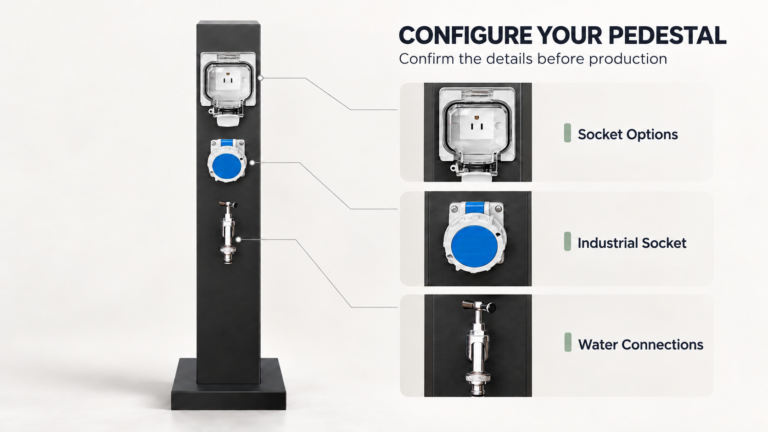
Depending on the selected model and confirmed configuration, customization options include:
- Electrical socket types for different destination markets.
- Socket quantities and placement.
- Water connections with 1/2-inch or 3/4-inch options.
- Lighting with button, light-sensor, motion-sensor or Wi-Fi control options.
- RCCBs and circuit breakers.
- 304 stainless steel construction and enclosure finishes.
For projects specifying IP66, confirm the rating for the complete selected assembly and its intended operating condition, including whether plugs are connected.
Share your pitch plan and required configuration so we can review suitable product options with your project team.
What to Send for a Project Quotation
To help us prepare a relevant quotation, please provide:
- Project country and delivery location.
- Total number of RV pitches.
- A pitch layout or simple site drawing.
- Preferred dedicated or shared arrangement.
- Socket type, quantity, voltage and current requirements.
- Water connection sizes and tap quantities.
- Lighting, protection and metering requirements.
- Order quantity and target delivery date.
If the layout has not been finalized, mark the proposed pedestal locations on your drawing and identify which pitches each unit should serve.
Planning a new RV park or upgrading existing pitches? Contact GuaiChong with your layout and configuration requirements to request product information and a quotation.
FAQ
Can one RV utility pedestal serve two pitches?
Yes, when the pedestal is designed and configured for that purpose and the site installation supports it. Socket quantity alone does not confirm suitability. Placement, capacity, protection, water connections and metering should all be reviewed.
Does a pedestal with two sockets provide independent power for two RVs?
Not necessarily. Two sockets may share upstream equipment or metering. Ask the supplier to explain the circuit arrangement and confirm how each pitch will be supplied, protected and measured.
Are shared RV pedestals always cheaper?
No. They may reduce enclosure and mounting quantities, but the complete cost depends on internal equipment, underground services, installation and maintenance.
Can a shared pedestal have a separate water tap for each pitch?
Yes, this can be included in the configuration request. Confirm the tap positions, connection sizes and hose routes before production.
Can each pitch have its own energy meter in a shared enclosure?
This can be specified for technical review. Confirm the required meter type, reading method and any approvals needed for consumption-based billing.
Can GuaiChong customize sockets and water connections?
Yes. Socket types and quantities can be customized for the project. Water connections can be specified with 1/2-inch or 3/4-inch options, with the exact connection position and thread standard confirmed before production.
Which lighting controls are available?
Depending on the model, lighting control options include a button switch, light sensor, motion sensor or Wi-Fi control.
What information is needed to choose between dedicated and shared pedestals?
Start with the pitch layout, vehicle parking direction, connection distances and required electrical service. Then confirm water connections, metering, maintenance access and local project requirements.