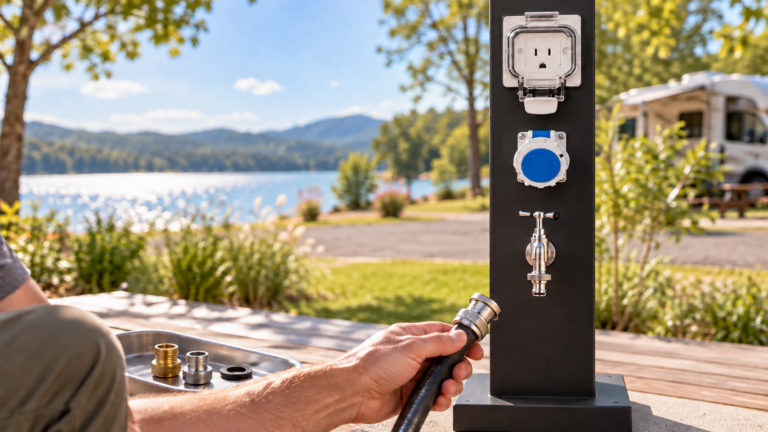

Custom Water and Power Pedestals: What to Include in Your Project Specification
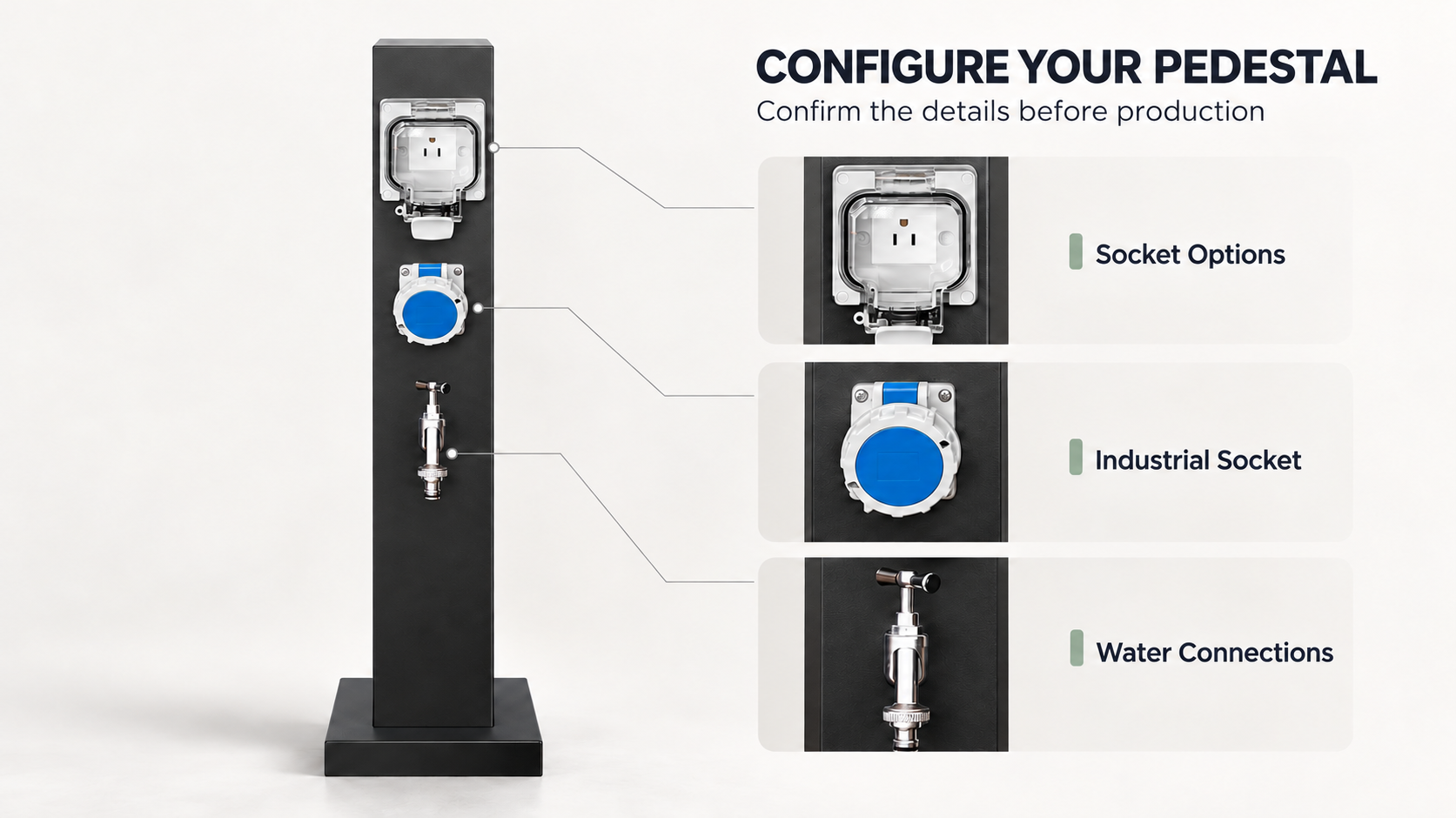
A request for “two sockets, one faucet and a light” is a useful starting point. Before production, however, several details still need to be confirmed: the socket standard, component positions, water connections, lighting controls and installation arrangement.
A clear specification for custom water and power pedestals helps buyers and manufacturers work from the same information. It also gives installers a practical reference when preparing the site.
This guide explains what to include in your project specification and how to turn an initial idea into an approved configuration.
1. Describe the Installation Environment
Start by explaining where the pedestals will be installed and how people will use them.
Typical applications include:
- RV parks and campgrounds.
- Marinas and waterfront facilities.
- Garden and courtyard projects.
- Outdoor parking and recreational areas.
Include the destination country, approximate quantity and any relevant environmental conditions, such as coastal exposure, freezing weather or frequent public use.
Photographs of the installation area can help explain access, available space and the surrounding surfaces. If you have a site plan, mark the proposed pedestal locations and assign each location an identification number.
For projects with several configurations, group the units by type rather than describing every pedestal as identical.
2. Specify the Electrical Outlets Clearly
Socket appearance alone is not enough to define an electrical configuration.
For each socket type, confirm:
| Item | Information to provide |
|---|---|
| Socket standard | Destination-country standard, industrial connector type or exact model |
| Quantity | Number of socket modules per pedestal |
| Connection points | Total number of plugs that can be connected |
| Voltage and frequency | Required supply characteristics |
| Current rating | Required rating for each outlet |
| Position | Front, rear, left or right side |
| Protection | Required cover and environmental protection |
| Reference | Product photograph, drawing or component specification |
Distinguish between the number of socket modules and the number of plug positions. For example, “two outlets” may be understood differently by the buyer and manufacturer.
A clearer description would be:
One duplex socket module, providing two plug positions, installed on the front face.
If you need two separate duplex modules, state that explicitly and confirm their positions on the drawing.
Where an exact component is required, provide its manufacturer and model number.
Explore our outdoor power pedestals to compare available socket configurations.
3. Confirm Protection, Metering and Control Requirements
Discuss protective devices separately from socket selection.
Depending on the project, the specification may include circuit breakers, residual-current protection or GFCI receptacles. Provide any required component models, electrical characteristics and certification requirements for technical review.
Do not assume that selecting a particular socket automatically defines the complete protection arrangement.
For metering, explain whether you need:
- One meter for the complete pedestal.
- Independent metering for each outlet.
- A local display.
- Remote consumption readings.
For remote control, describe the actual functions required. Examples include switching an outlet on and off, viewing energy consumption or controlling a water valve.
If integration with another platform is required, provide its communication protocol and technical documentation. Requirements such as OCPP, Modbus or an API should be reviewed before quotation and confirmed before production.
“Wi-Fi control” should also identify what is being controlled. Wi-Fi lighting control does not, by itself, specify remote outlet switching or energy monitoring.
4. Define the Water Configuration
For a combined water and electric pedestal, list each water connection separately.
Confirm:
- Number and style of faucets.
- Required inlet and outlet sizes.
- Thread standard.
- Connection positions.
- Hose connector requirements.
- Shut-off or control requirements.
- Any winterization requirements.
GuaiChong offers selectable 1/2-inch or 3/4-inch water connections for applicable configurations. The final specification should identify which connection each size refers to.
For example, if the inlet and faucet outlet have different sizes, show both on the drawing.
A nominal size such as 3/4 inch does not fully describe a threaded connection. Provide the thread standard or the specification of the mating fitting where compatibility matters.
For freezing conditions, explain how the complete water system will be protected or drained. Confirm these arrangements with the site installer before finalizing the configuration.
5. Choose the Lighting Control Mode
If the pedestal includes lighting, confirm both the light arrangement and the control method.
GuaiChong provides four lighting-control options for applicable models:
| Control option | Function to confirm |
|---|---|
| Push-button control | Local operation using a button |
| Photocell control | Operation according to ambient light |
| Motion-sensor control | Operation triggered by detected movement |
| Wi-Fi smart control | Lighting operation through the supported smart-control system |
Also confirm the preferred light color, diffuser appearance and position.
For motion-sensor lighting, discuss the intended detection area and operating behavior. For Wi-Fi lighting, review network availability at the installation location.
Keep lighting control separate from any requirements for outlet control, billing or energy management.
6. Confirm Dimensions, Material and Finish
Write dimensions with their orientation and units.
For example:
Height × Width × Depth: 800 × 120 × 120 mm
Specify the base separately if it projects beyond the column. Clarify whether the overall height includes the base, top light or other accessories.
The appearance specification should identify:
- Enclosure material.
- Surface finish.
- Color reference.
- Top design.
- Base design.
- Access-door position.
- Any logo or identification requirements.
If selecting 304 stainless steel, state whether the required appearance is a visible stainless finish or a powder-coated surface.
Use a color code or approved sample where color matching is important. Photographs are helpful references, but screen settings and lighting can change how a finish appears.
Watch our 304 vs 201 stainless steel comparison video for a closer look at the material test.
7. Define the Required Environmental Protection
If IP66 is required, include it explicitly in the project specification and ask the manufacturer to confirm the applicable assembled configuration.
Clarify whether the stated protection applies with socket covers closed, with a compatible plug connected, or under other specified conditions.
The enclosure, sockets, covers, seals and cable entries must be reviewed together. A component’s individual rating should not be treated as confirmation of the complete pedestal’s rating.
Any required supporting documentation should be discussed before the order is finalized.
8. Show Mounting and Service Access
A pedestal drawing should help the installer prepare the mounting surface, incoming cables and water connections.
Confirm the following details where applicable:
- Base dimensions and fixing-hole positions.
- Cable-entry position.
- Water-entry position.
- Internal connection area.
- Access-door opening direction.
- Space needed for servicing.
- Mounting hardware supplied with the product.
The site installer should review the arrangement before foundations, cable routes and water lines are completed.
If the product must fit an existing installation, provide measured dimensions and photographs. Do not rely on approximate measurements when matching an existing base or connection position.
Read our RV utility pedestal placement guide when planning access, parking layout and connection routes.
9. Approve the Layout Before Production
Use the final drawing to check where every component will be installed.
Front, side and bottom views are particularly useful for confirming socket positions, faucet locations, cable entries and mounting details.
Before approval, check:
- Model and quantity.
- Overall and base dimensions.
- Socket types, quantities and positions.
- Protective devices and metering.
- Water fittings and connection details.
- Lighting and control mode.
- Material, color and finish.
- Mounting and access arrangements.
Give the approved drawing a revision number and date. The order confirmation should refer to that revision.
If a requirement changes later, request an updated drawing and confirmation of any effect on price or lead time before proceeding.
10. Project Specification Template
Copy the checklist below and complete the items you already know. Mark undecided items as “to be confirmed” so they remain visible during the review.
| Specification item | Your project details |
|---|---|
| Destination country | |
| Application | |
| Quantity by configuration | |
| Pedestal dimensions and units | |
| Base dimensions and mounting method | |
| Enclosure material and finish | |
| Color reference | |
| Socket standard or model | |
| Number of modules and plug positions | |
| Voltage, frequency and current ratings | |
| Socket positions | |
| Protective-device requirements | |
| Metering requirements | |
| Remote-control or integration requirements | |
| Number and style of faucets | |
| Water inlet size and thread standard | |
| Water outlet size and thread standard | |
| Lighting and control mode | |
| Required environmental protection | |
| Required certifications or documents | |
| Cable and water entry positions | |
| Target delivery date | |
| Approved drawing reference |
Discuss Your Custom Pedestal Configuration
GuaiChong supplies custom water and power pedestals for RV parks, campgrounds, marinas and outdoor projects.
Configuration options include destination-specific sockets, water fittings, lighting controls, dimensions and finishes, subject to the selected model and technical review.
Send us your project location, quantity, reference photographs and completed specification checklist. We can review the requirements and help prepare a configuration for quotation and drawing confirmation.
Send us your project specifications to discuss your required configuration and request a quotation.